


On this page
To produce effective instructions for your warehouse workers, you should consider writing them in simple language. By doing so, you can make sure that everybody properly understands what to do at work and why — no matter their reading level or how long they have been learning the local language. By focusing on the understanding of work instructions, you will improve safety in your warehouse, because suddenly everybody understands the rules. There is a production benefit too: you will reduce costs because your workers will make fewer mistakes. Once approved, you can also use your instructions as a template for further instructions — for new procedures, machines, or tools. Convinced? Then go ahead!
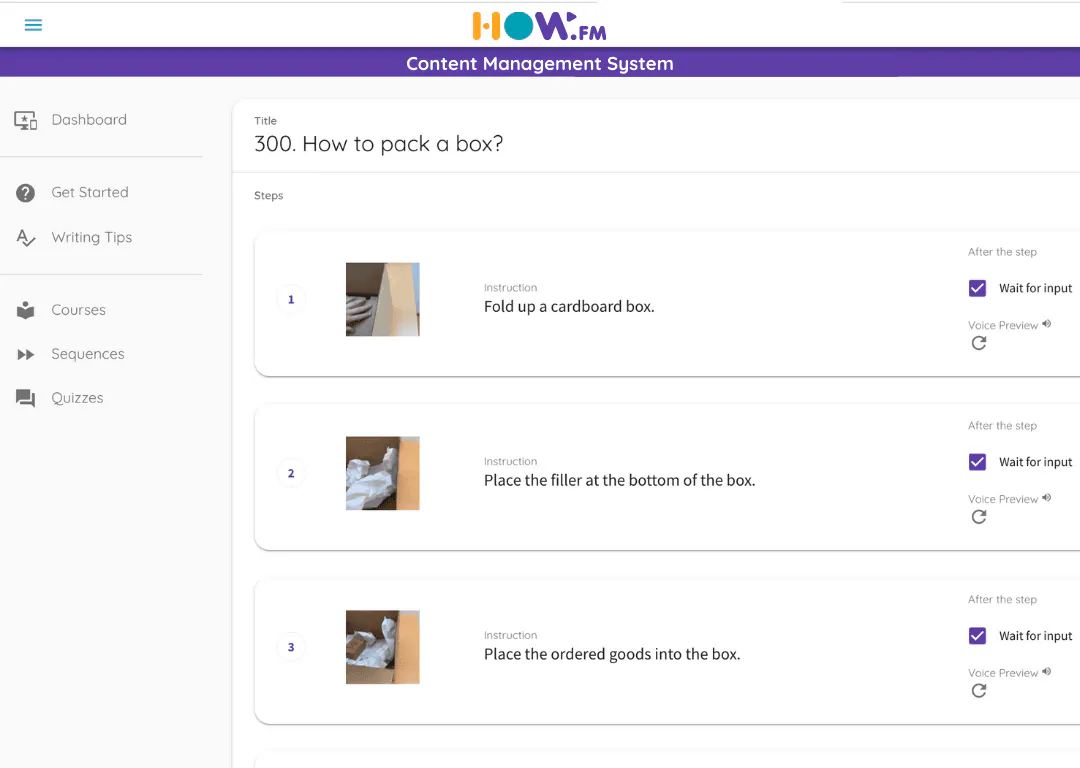
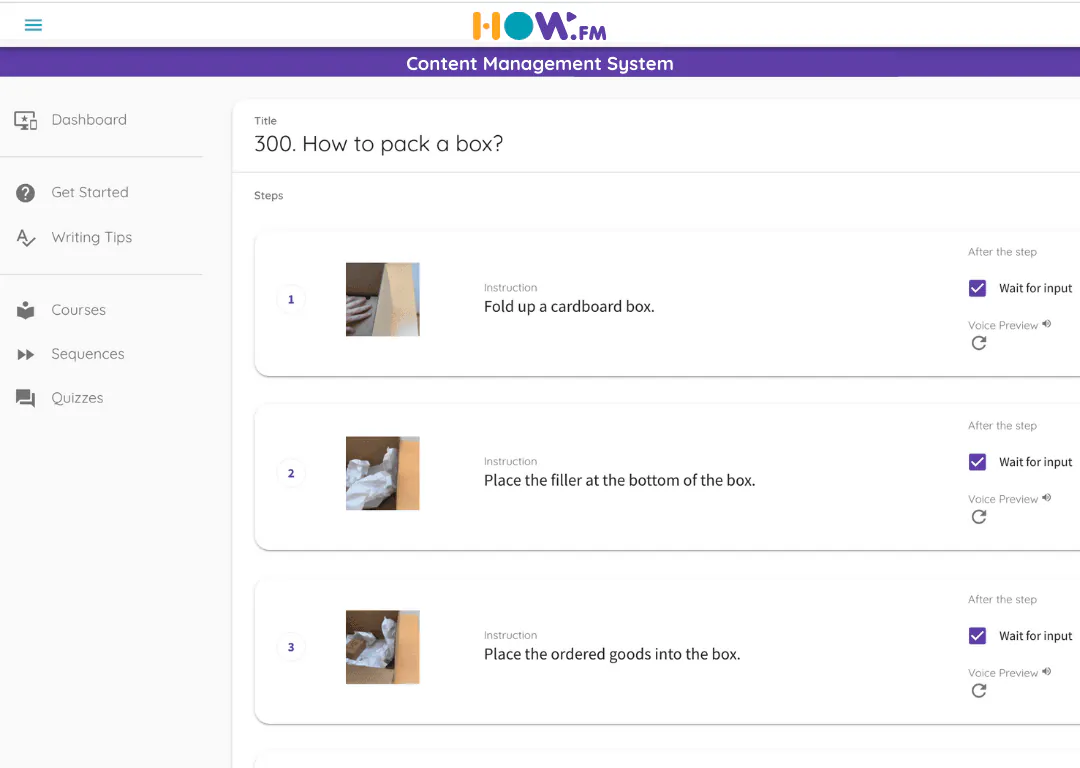 Most digital training software helps you create work instructions in Simplified Technical English for your workers.
What Is Simplified Language?
The development of Simplified Technical English (short: STE) goes back to the early 1980s. The developers’ aim was to form a language that makes technical matters understandable for speakers of English as their second language.
It is based on a restricted set of language rules and a dictionary with words and word forms to use and those to avoid. Technical writers still use this set of rules for their work.
Originally, STE was developed for aerospace industry maintenance manuals. Maybe you’ve also come across so-called plain language, which more and more administrative and government-related texts are written in. After reading this article, you will understand how to use simple language rules to write effective instructions for standard procedures in your logistics company.
Why Do I Need Simplified Technical English?
As an employer in the logistics industry, your workforce probably consists of employees from different countries and cultures. It is a matter of respect and of security to offer work and health and safety instructions in different languages. When it comes to translating your instructions, it’s important to have unambiguous source texts to give to the translators. This reduces cost because the translation will be easier for them, and they will make fewer mistakes if you use clear and simple language. Also, standardized and clear writing facilitates machine translation, which is a faster, cheaper, and therefore more efficient translation process (especially if you need your training or work safety documents translated into many languages).
Learn About the Writing Rules
The ASD-STE100 specification includes a set of 65 writing rules and a dictionary of about 900 allowed words. They help technical writers to write effective instructions by using simple language. What does that mean, simple language?
The writing rules of STE are about grammar and style. They demand simple words and simple sentences. That means you have to avoid words consisting of many syllables, foreign words, jargon, and abbreviations. So-called noun clusters should not consist of more than three words. Use as many technical terms as necessary and always explain them. Establish and use specific terminology where it is needed. If you try to avoid them, you might start to blather. Do not look for alternative expressions; once you’ve used a word, stick to using it in all your instructions. However, always think about the words before you use them in terms of familiarity: Don’t come up with fancy, high-brow words but use the form your staff most likely knows. Avoid hard words, which means that going for the short word is always a good choice.
Keep your sentences short (about 20 to 25 words per sentence) and avoid complex structures. This will be easier if you use simple forms of present, past, and future tense. At the same time, avoid present participles or gerunds (unless they’re part of a set technical expression like in ‘packing table’).
Sentences also become simpler automatically if you use the active voice exclusively. Since you want your employees to act, use the imperative. So, instead of telling your workers “The battery is charged” make them act by saying “Charge the battery”. Put commands like these first when your instruction includes a warning.
Another rule is that of relevance. You have to scan your instructional texts for irrelevant information and delete it.
The outer outline of your training, no matter whether you’re giving it to your employees in written or in spoken form, should consist of one sentence per step in the process you’re explaining to your worker. These bites of information will be easier to understand and digest. English is a language with plenty of ambiguous words and the forms of nouns and their corresponding verbs often look the same. Using articles where it’s possible helps the worker distinguish more easily between words that require action, meaning verbs, and nouns.
Caution: How to Use Words Concisely
The developers of Simplified Technical English (STE) came up with a dictionary of about 900 allowed words. Here, you can not only see what words and what forms you should use but also which ones you should avoid.
The first rule this follows is to use ambiguous words only to express one of many meanings. This makes your instructions concise, and your employees never have to reread or listen again to the instruction to find out what meaning you’re talking about exactly.
This means: use words with their actual, not their transferred meaning. Don’t use the same word once as a verb and once as an adjective, for example, the word ‘close’ is okay as a verb in ‘close the door’ but not as an adjective meaning ‘near’. Otherwise, you confuse your workers.
It’s useful to collect words from your technical documentation and decide which of them are concise and exclude variants from the list of words you are going to use in your instructions.
Tips for Writing Effective Work Instructions in Simplified Technical English
It’s always a good idea to ask an expert for help. Professional technical writers can make your instructional documents fit STE standards. There are also software solutions that guide you on your way to effective instructional texts. In addition, there are products that provide your instructions in the right language for your workers right away.
If you want to try enhancing the understandability of your instructions by yourself, try our 11 tips:
- Put important messages at the start
- Use short and simple words. No hard words!
- Write short sentences; about 15-25 words
- Put one step in one sentence
- Divide your instructions into small chunks. Make step-by-step instructions
- Avoid words with several meanings. But, if you have to use ambiguous words, only use them with ONE of their meanings
- Avoid long words. Use words with more common use, i.e. use instead of utilize
- Avoid abbreviations. If you do use them, explain them!
- Delete all redundant words
- Use the active voice. Never use the passive voice!
- Use simple tenses (past, present, and future)
Put the action first in a command, then explain why you want your workers to do it.
Take the Next Step
Simple language is half the battle — showing the work is the other half. Our guide to visual work instructions covers how photos, video, and voice-over turn a well-written standard into one that every worker actually follows.