


On this page
- Why Onboarding Matters
- Set strategic onboarding goals
- The First Day, Hour by Hour
- Make use of new technology to match next-gen employee needs
- High-Volume Onboarding: When Dozens Start on the Same Monday
- Onboarding a Multilingual Workforce
- Development phases for new employees
- Employee retention starts with a good onboarding experience
After navigating the process to recruit talented blue-collar workers for your site, you may be patting yourself on the back while thinking that you have achieved the most important warehouse manager goal: having a great team in place that can manage the upcoming demands of your customer. But unfortunately, recruiting is simply the initial step. In order to establish a good relationship with your new employees, you have to implement a best-in-class warehouse worker onboarding process. Use the following onboarding best practices to begin your journey to employer of the year.

Why Onboarding Matters
This may come as a surprise, but onboarding warehouse workers begins with the first contact with a potential new hire. Every interaction is an opportunity to build and establish engagement. It allows your newbies to quickly embrace the most important goals and learn the necessary skills to become successful. As safety is a top priority in blue-collar work environments, onboarding first communicates, and demonstrates, safety compliance measures. Over the course of the onboarding phase, also share context around your organization’s brand and values. Warehouse workers should be introduced to the culture as well as learn about your performance expectations before they dive into on-the-job training around work instructions.
Effective onboarding can boost growth, build trust, foster open communication, and reduce turnover.
Research supporting these ideas reveals four clear onboarding goals:
- Improve employee performance – Clearly communicating expectations and providing performance feedback during the onboarding phase leads to an improvement in performance. New employees who participated in onboarding programs experienced up to 11% improved performance. Given the ever-growing logistics industry, worker performance matters more than ever. Especially third-party logistics companies have to match their service level agreements in terms of time and quality to secure a contract renewal.
- Accelerate time-to-productivity – A solid and well-structured onboarding will result in new employees achieving full productivity levels weeks or sometimes months sooner. As recruitment for blue-collar jobs becomes more challenging, onboarding can provide the competitive edge you need to meet client demands.
- Increase employee engagement – Cultivating an environment of teamwork and mentorship is no easy feat. But onboarding can be the first step to achieving these goals, resulting in greater employee engagement. Studies have shown a direct correlation between quality onboarding and high employee engagement, resulting in lower employee turnover.
- Increase employee retention – Logistics jobs see higher rates of turnover and seasonality. The estimated cost to replace an employee can be thousands of dollars; other sources report costs up to a full year’s salary. The vast majority of new employees decide within their first six months if they plan to stay. HR industry studies show that almost 20% of workers leave within the first 45 days of employment. Research suggests that companies are more likely to retain new workers if they participate in a well-organized onboarding program.
Set strategic onboarding goals
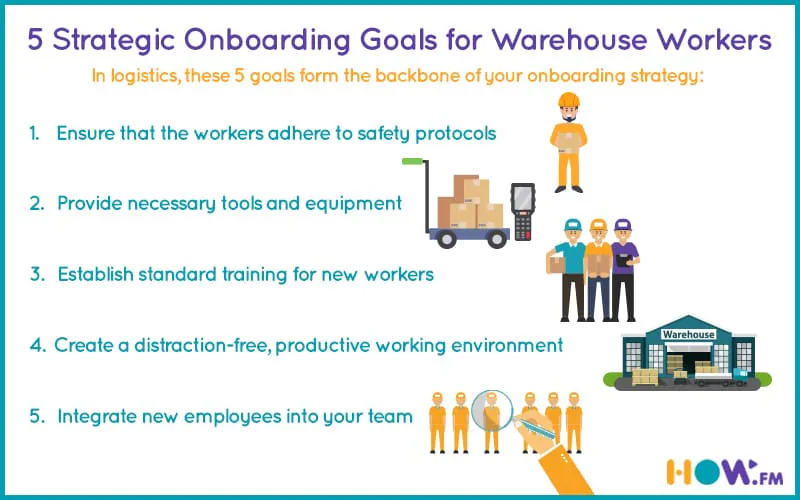
When hiring new employees, your management goal is to ensure that they are able and empowered to deliver quality work independently. However, you may be treating onboarding like a race instead of a journey.
In order to achieve the maximum results of onboarding, your goals must be clear. For this reason, strategic goals should be clearly defined and agreed upon by your management or training team. General goals include making employees feel welcome within their team and at large, fostering engagement, and introductions to other teams they partner with. Strategic onboarding bridges the gap from “new hire” to “productive employee”. This form of onboarding allows new employees to forge relationships, enabling them to fully contribute to your success in business.
Onboarding goals for the logistics sector include:
- making sure the worker is safe while adhering to established safety protocols
- ensuring that the employee has the tools necessary to complete the job
- confirming that the new worker is able to deliver the desired quality of work
- providing an environment for the worker to be productive while achieving target goals
- integration of the new employee as a valuable and integral part of the team
Over 60% of employers state that integrating employees into the organizational culture is a primary goal of onboarding. However, there is no “one size fits all” culture. Your individual culture is a result of hierarchy (or “red tape”), demonstrated values, and even subcultures at individual facility locations or within teams. Company leaders must define and display the desired culture before expecting new workers to model the behavior.
Also Read: 5 Tips to Attract and Integrate New Warehouse Workers
The First Day, Hour by Hour
Strategy matters, but the first day is won or lost in logistics: badges, lockers, PPE, and a plan. A new worker who spends their first morning waiting at reception has already learned something about your site, and it isn’t good. A workable day-one schedule for a warehouse looks like this:
- Before arrival: badge, locker, scanner login, and correctly sized PPE prepared; team lead and buddy informed; workstation for training reserved.
- First hour: personal welcome by the team lead, not just HR. Site tour with the safety essentials shown in place: emergency exits, assembly point, first aiders, pedestrian walkways.
- Mid-morning: safety instruction and compliance sign-offs, delivered in a language the worker actually understands, with a short quiz rather than just a signature.
- After lunch (with the team, never alone): first guided task at a low-pressure station. The goal is one small success on day one, not rate.
- Last 30 minutes: short debrief with the buddy or team lead. What was unclear? What’s the plan for tomorrow? Confirm the worker knows exactly when to arrive and who to report to.
The pattern behind the schedule: safety first, one real task, one human connection, zero waiting around. If you only fix one thing about your onboarding, fix day one.
Make use of new technology to match next-gen employee needs
Especially as a new generation of logistics employees enters the workforce, incorporate technology into your onboarding and training processes wherever helpful or expected. Digital training is cost-effective and allows for self-paced learning — and it can easily be leveraged over and over again. Additionally, technology-based training allows new employees to complete short modules without front-loading everything into one training session, which can easily be too much to digest at once. Online learning is an efficient option for compliance training and theoretical skills training. Here, industry and other background knowledge can be conveyed in self-paced tutorials, too.
However, technology alone cannot replicate the relationship-building aspect of in-person training. Online training is 96% as effective as face-to-face. For this reason, blended learning combines the best of both worlds. Blended learning balances the more engaging in-person training with the benefits of online training. This combination of training methods is appealing because it meets the needs of individual learning styles (auditory, visual, and kinesthetic) as well as trying things out in practice, under the supervision of a mentor or team lead.
Online training is multi-faceted. It may include off- and on-the-job training elements. how.fm offers a digital onboarding and training solution that allows you to document, update, and share your occupational knowledge in real time. Warehouse workers can access this information 24/7.
The use of technology for onboarding can begin the moment a worker accepts a job offer or temp staff is assigned to a site. Site managers, along with HR teams, can save time and provide a consistent hiring and onboarding experience through software-based automation. The process of preparing new-hire paperwork and requesting security badges can often be automated. Hereafter, self-onboarding on autopilot allows warehouse managers to improve ramp-up times, output, and quality while avoiding work-time delays. When deliberate automation is used as part of a larger onboarding process, new employees are more engaged (49%) and confident (46%) with higher productivity (42%).
High-Volume Onboarding: When Dozens Start on the Same Monday
Onboarding one worker well is a process question. Onboarding a peak-season cohort is an operations question. Logistics sites routinely take on very large groups ahead of peak, and the approach that works for a single hire collapses when the group is that size and the calendar is fixed. What changes:
- Stagger the cohorts. Twenty starters per day for five days beats a hundred on Monday. Your trainers, equipment, and badge printers have a capacity limit; plan intake against it like you plan dock slots.
- Split the content. Everything theoretical, site rules, safety basics, and system introductions goes into self-paced modules workers complete individually. Face-to-face time is reserved for what needs hands: the station, the equipment, the team.
- Fix the buddy ratio. One experienced worker can genuinely support two or three starters, not ten. If you don’t have enough buddies, that is your real constraint; stagger harder.
- Check on day 3, not day 30. With seasonal workers, the decision to stay or quietly quit happens in the first week. A five-minute conversation per starter on day three catches problems while they’re still cheap to fix.
Temporary workers deserve the same safety onboarding as permanent staff; legally they’re entitled to it, and statistically they need it more. Our guides on onboarding temporary warehouse workers and simplifying onboarding for seasonal workers go deeper on the peak playbook.
Onboarding a Multilingual Workforce
Many warehouses today run with five to ten native languages on a single site. Onboarding that exists only in the local language doesn’t just slow those workers down; it quietly converts your safety instruction into a formality nobody understood.
Three practices make multilingual onboarding work in reality:
- Deliver core content in the worker’s own language. Translated, voiced-over modules mean a new hire learns the pallet-stacking rule in Romanian or Arabic, not in broken pantomime. Voice-over matters, since reading skills vary; never assume literacy in any language.
- Make instructions visual. Photos, short videos, and demonstrations at the station carry meaning across every language barrier. A good visual SOP needs almost no translation.
- Verify understanding, don’t assume it. A nod is not comprehension. Short quizzes in the worker’s language, or asking them to demonstrate the task, confirm that the message landed, and give you documentation for audits.
Sites that get this right also gain a hiring advantage: they can recruit motivated workers whom competitors reject over language, which matters in every tight labor market. More on this in language barriers in warehouses.
Development phases for new employees
As previously stated, onboarding warehouse workers is the initial phase of new employee development. The entire process might take from a few hours to a few months, depending on the job role and training program.
When new employee development is broken down into phases, it is easier for managers, HR, and training teams to identify what needs to be executed. The goal is to create a mutually beneficial journey for you and your employees.
The new employee development phases allow you, the warehouse or operations manager, to better assess the goals, skills, and motivators of new workers. Investing in temporary, part-time, and full-time hires saves you time and money while reducing the odds of turnover.
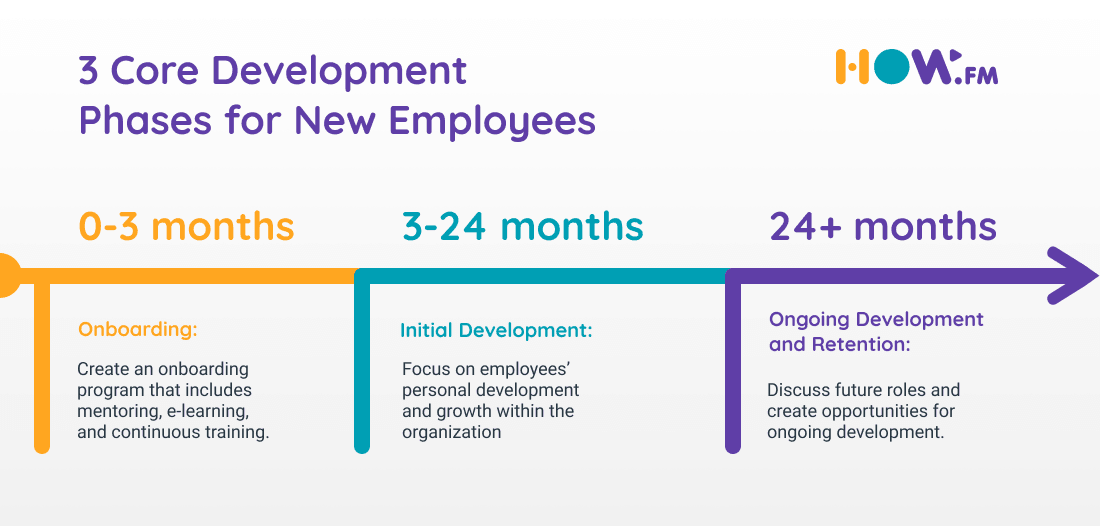
Onboarding: 0-3 months
Most organizations, across all industries, agree that 90 days is the gold standard for onboarding. Yet most onboarding programs end within an hour, a day, or a week. Some onboarding programs only last a few minutes or are not put in place at all. All too many organizations confuse “onboarding” with “orientation” and end the phase after new-hire paperwork is completed.
Best practices show that strategic and deliberate onboarding creates a solid foundation for the worker’s engagement and performance.
Consider including the following best practices in the onboarding phase:
- Pre-plan onboarding steps to include mentoring and e-learning
- Include theoretical, practical, health and safety, and compliance training
- Personally introduce new employees to teammates, team leads, and site managers
- Establish 30-, 60-, and 90-day SMART goals (Specific, Measurable, Attainable, Relevant, and Time-Bound)
- Schedule orientation as one step in the onboarding phase, usually at the very beginning
- Demonstrate work tasks
- Make presentations, guides, and policy documents or SOPs easily accessible
- Explain how the role fits into the greater supply chain, your customer’s world, and their needs
- Provide and ask for feedback at the beginning and throughout the entire onboarding process
Initial Development: 3-24 months
During the initial development phase, blue-collar workers are starting to feel confident in their performance. They are ready to master their role and hone their craft.
As they build relationships across your site and learn more about how they fit into the bigger puzzle, employees will start to consider future opportunities to learn and grow.
Now is the time to have conversations about personal development. By investing in individual employees, you are investing in the future and vitality of your company. Determine their goals and desired career path. Or would they prefer to stay and grow in their current role?
The following activities should be completed during the employee’s initial development phase:
- Conduct a new-hire survey after 90 days to measure the success of onboarding
- Assign a mentor
- Revisit SMART goals
- Assess additional learning needs related to the role
- Provide additional bite-sized training (online or in-person) about the company’s other processes or clients
- Organize team-building activities
- Schedule a one-on-one monthly “check-in” between the employee and their direct manager
- Provide and ask for feedback
Ongoing Development and Retention: 24+ months
After two years with a company, employees are likely subject matter experts (“SMEs”) in their roles. Some are content to stay put, but many others are interested in continued learning.
Acknowledge and discuss the future roles of the employee. Do they desire to be a shift leader? Or would they like to transfer to another station or line? Maybe they want to mentor new hires. Recognizing employee desires and providing ongoing development reduces turnover and drives engagement.
As always, continue to provide and ask for employee feedback. In a culture of continuous feedback, employees will be expected to give, and therefore receive, feedback.
Employee retention starts with a good onboarding experience
The new generation of blue-collar workers has different expectations than in the past. They are tech-savvy and more likely to expect ongoing development throughout the course of their career. To ensure well-run operations, retaining quality employees is more important than ever.
The first step to retaining employees is to implement a thorough new employee development program, beginning with onboarding. In short, the best way to achieve the end goal is to focus on the beginning.
Follow how.fm to stay ahead of best practices for blue-collar onboarding, training, re-training, and upskilling!
Everything in this guide gets easier when the repeatable parts run themselves. how.fm turns your onboarding content into structured, self-paced training in each worker’s own language, so every starter, whether one or one hundred, gets the same solid first week.
Want to see what effortless onboarding looks like for your blue-collar workers?
Free download
Download our free onboarding template
Build a stronger first day, first week, and first 90 days with a practical template for warehouse teams.