


On this page
- Brief History of Women in Warehouses and Factory Jobs
- What Is It Like Working in a Warehouse as a Woman?
- Is working in a warehouse worth it?
- Is It True That Women Aren’t Strong Enough for Warehouse Jobs?
- What Warehouses Get Wrong When Recruiting Women
- How To Make Warehouse and Factory Work for Women More Accessible
- How to Know Whether It’s Working: Metrics That Matter
- 📌 Template: Sexual Harassment Prevention Training
Traditionally, warehouse work has most often been thought of as men’s work. Women in warehouses are more common than they once were, but it is still a male-dominated industry.
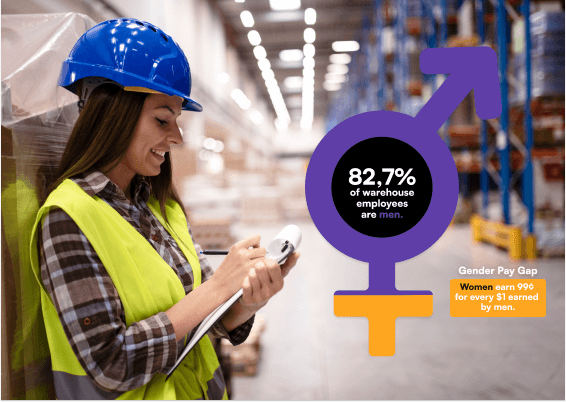
In the US, only 17.3% of all warehouse employees are women, while 82.7% are men. However, there are some meaningful advancements for women in warehouses. We’ll discuss what it’s like for women in warehouses, whether warehouse work is a good job choice for women, and what managers can concretely change to make their sites work for everyone.
Brief History of Women in Warehouses and Factory Jobs
It was very rare for women to work in warehouses in the early 20th century. During WWI, women began working in warehouses in the U.S. and Europe. There were labor shortages while men were away fighting.
Women worked in factories and warehouses, making, moving, and storing a variety of items both for the war effort and for the home front. Women made substantially less than men had for the same jobs. When the war ended, soldiers came home and wanted their jobs back.
Many women stopped working in warehouses. However, other women were unwilling to give up the freedom and wages of warehouse work. Women pushed back and gradually gained momentum in factory work and warehouses. However, there are still significant gaps in wages and the number of female employees in factories and warehouses.
What Is It Like Working in a Warehouse as a Woman?
Some women enjoy working in warehouses, while others decide it is not for them. Different women have different experiences in regard to how they are treated by their male co-workers and supervisors. For some women, the job coordinates with other aspects of their life. For others, family and childcare are hard to balance. Women also vary in how they feel they do at their jobs.
Physical Work Experience
One thing that almost all women seem to agree on is that the work is physically taxing. Here is some of the advice offered about women working in warehouses on Reddit and Quora:
“Bring a spare pair of sneakers and leave them in your car. If your feet get too bad, you can always run out to your car on break and change them. It makes a big difference.” - ILikeEmNekkid
“It’s physically demanding, but I’d say it’s less demanding of muscles and more requires that you have strong bones. You’re working constantly in certain positions and you need willpower.” - Free-Value
“Physically, it’s more about walking than anything else. Just have good shoes and insoles because it takes the body a couple of weeks to adjust to the amount of walking and standing around” -PKspyder
Lots of advice focuses on what kind of shoes and socks to wear. Staying hydrated, taking Tylenol and Advil, and generally handling the physical strain of warehouse work are also big topics. It’s fair to assume that if you aren’t physically fit and able to spend significant stretches of time on your feet, warehouse work may not be for you. This is true whether you’re a man or a woman.
Experience With Male Coworkers and Managers
Other comments on being a female warehouse worker involve the question of gender and how women in warehouses relate to male colleagues and supervisors. Some warehouse workers find that women receive positive special treatment at warehouses. Others believe men and women are treated equally or that women aren’t treated as fairly as men:
“at my department they tend to avoid giving women the more laborious jobs and even then if you do get something like that you could ask for something else because its too much for you” -PKspyder
“Don’t try and look cute …maybe try and look as unappealing as possible because men…lol…” -jwoo3x
“we’re not mostly male. Even the leadership is generally very diverse.” - Ulthirm
“If you want to work in a warehouse in the US, I’m sure you can be hired since there is little sex discrimination, despite what the TV pundits tell you. However, you better be ready to do the same stuff your male counterparts do, without complaining that “it’s too heavy”, and not constantly on disability leave because you hurt yourself.” - Diane Toler
It’s striking how differently women seem to experience working in warehouses. About the only thing that everybody agrees on is that the work is physically taxing.
It may be that the reason women have such different experiences working in warehouses is that they’re treated differently at various warehouses. Depending on how a warehouse trains, handles, and promotes female employees, it may have women who work and thrive in various positions for years, or managers may find that female employees rapidly quit.
Is working in a warehouse worth it?
Advantages
- Avoid a sedentary lifestyle and be healthier
- Decent money
- Don’t need a lot of education or skills to get started
- Jobs may have flexible hours
- Jobs available almost everywhere
Downsides
- A physical job that requires strength and repetition
- Disconnect between management and employees (could be improved by a great training program like how.fm)
- Experience varies a lot depending on the place. Possible to face discrimination or harassment.
- Long shifts are typical (upwards of 12-hour shifts)
- Women may tend to work harder than men in general according to some studies, which, in warehousing, can mean physical burnout.
Is It True That Women Aren’t Strong Enough for Warehouse Jobs?
Are women strong enough for warehouse jobs? It’s one of the most common questions in conversations around women doing warehouse work. Sometimes comments about women as warehouse workers are mired in sexism. However, just as often, women sincerely wonder whether they can handle warehouse work.
Before they get started, most warehouse workers seem to wonder whether they have what it takes to do warehouse work. This work is strenuous, tedious, and repetitive. Both men and women may struggle to be on their feet for long hours and lift heavy loads over and over.
However, most warehouse workers and managers seem to agree that while the strenuous nature of warehouse work rules out this kind of career for some people, both men and women, women can and do excel at warehouse work.
Whether someone is strong enough for a given job is something they need to determine for themselves. Here are some questions that managers and human resources can ask any applicant to help determine whether warehouse work will be too demanding:
- Are you comfortable lifting X weight up to X times a shift?
- Will you be able to be on your feet for X hours at a time?
- Does repetitive motion bother you?
- Do you feel comfortable making calculations for procedures like inventory while performing strenuous physical work?
For women who aren’t sure whether they’re up to the physical strain of warehouse jobs, it’s a good idea to keep in mind that picking and packing jobs may not require as much heavy lifting. These jobs do require being on your feet and moving rapidly around the warehouse to fill orders, but they often don’t involve quite as much heavy lifting as other kinds of warehouse jobs.
There is also an operations point hiding in this question. A task that requires brute strength is usually a task that hasn’t been engineered properly yet. Lifting aids, tilt tables, and sensible slotting reduce strain for every worker and cut injury risk across the whole crew, not just for women.
How Technology Is Changing the Experience of Women in Warehouses
Increasingly, advances in technology have enabled women to shine in the warehouse industry, even outcompeting their male peers. Women who learn how to use technology effectively can specialize in programming and maintaining machines instead of doing the heavy lifting and manual labor.
While many jobs in the warehouse industry still require a lot of physical strength and effort, the more warehouses automate, the more opportunities there are for work maintaining and operating the machines that do the work. However, women still have an uphill battle getting these high-tech, low-labor jobs. Only 10% of temp agencies offered forklift positions to women. On the other hand, 60% of agencies offered men these jobs.
That last statistic deserves a manager’s attention. If your agency partners rarely send women for equipment roles, the filter is happening before candidates ever reach you. Tell your agencies explicitly that you want women proposed for forklift and technical positions, and check the split in the profiles they send. What you don’t ask for, you won’t get.
What Warehouses Get Wrong When Recruiting Women
Many sites say they want more female applicants and then run a hiring process that quietly screens them out. The usual culprits are mundane, which is good news: mundane problems are fixable.
- Job ads written for the current workforce. Photos showing only men, language about “heavy lifting” as the headline requirement, and long lists of physical demands signal who the ad is “really” for. Lead with what the job actually rewards: accuracy, reliability, pace. State physical requirements honestly, but as facts, not as a gate.
- Referral-only pipelines. If hiring runs mainly on referrals from a mostly male crew, the pipeline reproduces the crew. Keep referrals, but add channels that reach different applicants.
- Rigid full-time shift blocks. Requiring availability for any shift at any time excludes many primary caregivers before the interview. If your roster could support fixed shifts or part-time blocks, say so in the ad.
- Facilities as an afterthought. Clean, secure changing rooms and sanitary facilities for women, and PPE actually ordered in women’s sizes, are basic. Ill-fitting gloves and safety shoes aren’t just uncomfortable; equipment that doesn’t fit is a safety problem, a point EU-OSHA and safety bodies have long made about PPE designed around a default male body.
None of this lowers any standard. It removes obstacles that have nothing to do with whether someone can do the job.
How To Make Warehouse and Factory Work for Women More Accessible
1. Flexible Hours Accommodate the Busy Schedules of Women in Warehouses
Flexible hours can open up any kind of job for people who have limited time availability, and the same is true for warehouse work. Women may be more likely to need to devote time to childcare or other family responsibilities.
Flexible hours make it much easier for women to access warehouse work. For warehouse managers, flexible scheduling can be a great way to fill difficult schedule gaps or accommodate the need for additional staffing when necessary.
In practice, the most workable models are fixed shifts that people can plan childcare around, shift swaps that workers arrange themselves within clear rules, and part-time blocks during your daily volume peaks. A four-hour packing shift over the midday peak can be a perfect match between a parent’s availability and your workload curve.
2. Great Training Enables Female Workers to Succeed
Good training with how.fm is one of the most powerful ways to make warehouses more accessible for women and help women to thrive in warehouse careers. Workers train with how.fm on the job, in small increments, making it easy to learn as you go.
This kind of training also enables women to learn more advanced skills whether or not a supervisor takes the time to train them. Incremental training is also important because it accommodates flexible hours, enabling women to learn as they work on a schedule that accommodates families and childcare.
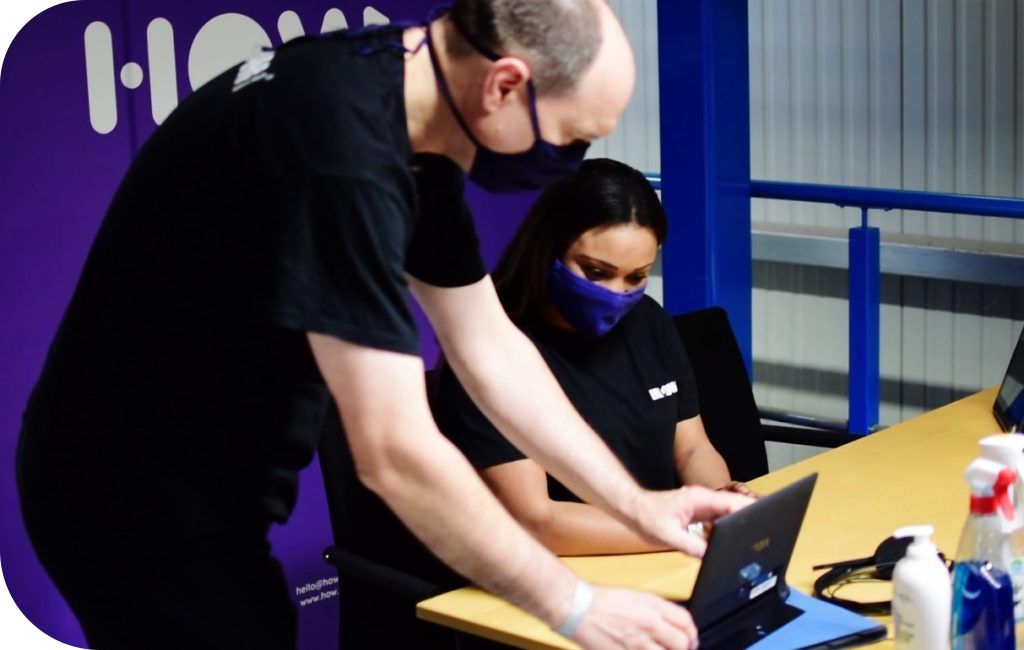 A warehouse employee receiving upskilling training using how.fm
how.fm training enables managers to tailor their existing training to new hires with no prior experience. By using how.fm for training refreshers when they need them, even women who are just beginning to enter warehouse work will feel comfortable as they learn.
Self-paced training also removes a subtle barrier: no one has to ask a (possibly skeptical) colleague to show them the reach truck a third time. The system explains it as often as needed, without judgment, in the worker’s own language.
3. Promote Women to Inspire and Encourage
Perhaps the most tangible way to encourage women to seek out warehouse work and stick with it is to promote those women when they do well. When women see other women succeed in the warehouse industry, they see the opportunity for success.
In an industry like warehouse work, where there is an assumption of a glass ceiling for women, a warehouse that promotes women is making a statement that women who work hard and stick with the company will be able to rise within its ranks.
Make the path visible and structured. Publish the requirements for team lead and trainer roles, track who gets cross-trained on equipment, and check that women are getting the same share of those qualifications. Promotion follows qualification; if the qualification pipeline is skewed, the leadership numbers will be too, no matter how fair the final decision feels.
4. Protect Women So They Feel Safe at Work
One of the greatest concerns mentioned by women who are considering warehouse work is the possibility of sexism and harassment on the warehouse floor. It is of the utmost importance that warehouse workers feel protected by management and workplace culture.
Managers can’t just wait for women to tell them if they’re having issues with harassment. Managers need to ask them, and ask their coworkers if they’ve seen anything either. If women report harassment, management needs to take them seriously.
Make sure that training covers sexual harassment company-wide. Having a warehouse where women feel safe and secure takes active work and engagement. It won’t just happen by itself.
How to Know Whether It’s Working: Metrics That Matter
Intentions don’t retain workers; conditions do. A handful of numbers, reviewed quarterly, tell you whether your site is actually becoming more accessible:
- Application share. What percentage of applicants are women, per channel? If one agency or job board sends you a far more balanced pipeline, shift budget toward it.
- 90-day retention by gender. Early attrition is where problems show first. If women leave in the first three months at a higher rate than men, look hard at onboarding, facilities, and team culture, in that order.
- Cross-training and certification share. Who holds forklift licenses and station qualifications? This predicts your future team leads.
- Exit interview themes. Ask every leaver, in a language they’re comfortable in, what would have made them stay. Patterns emerge fast, and they are rarely about the work itself.
You don’t need a people-analytics team for this. A spreadsheet and the discipline to look at it every quarter is enough to see whether the actions in this article are moving anything.
📌 Template: Sexual Harassment Prevention Training
Appropriate training is key to the success of your entire warehouse staff, but to help women feel included and supported in this historically male-dominated field, it is especially important to offer the best possible sexual harassment prevention training from the beginning and throughout their employment with you.
You want your female employees to feel that their needs are being met. You also don’t want to make assumptions based on gender. From the beginning, it’s important for managers to strike a balance. Train and support new male and female employees appropriately from the start. Get off on the right foot by downloading this sexual harassment training course to incorporate into your training program.
Download here
Conclusion
It is to the benefit of any warehouse to look for opportunities to increase female employment. Women have a lot to offer in the warehouse, and managers are missing out on an important opportunity to attract talent by not catering to them. The sites that get this right treat inclusion as an operations discipline: fair pipelines, equipment that fits, visible career paths, and training everyone can access.
That last piece is where how.fm fits naturally: self-paced training in each worker’s own language gives every new hire, woman or man, the same fair start on the floor.