



On this page
- What Does a Warehouse Picker Packer Do and What Skills Are Important?
- A Day in the Life of a Picker Packer
- Considerations in Picker and Packer Jobs for Your Warehouse
- Picker Packer Skills Matrix: What to Screen For and How
- Copy-Ready Picker Packer Job Description Template
- Common Mistakes in Picker Packer Job Ads
- Picker and Packer Jobs for Your Warehouse Description Template With Salary Ranges in 2022
Download the Picker and Packer Job Description Template With Salary Ranges in 2022
Warehouse picker packers are typically the backbone of any warehouse. These are the people who actually get orders filled and sent out. This is also one of the positions with the highest turnover, so you may find that you’re posting picker and packer jobs for your warehouse and hiring almost all of the time.
Here’s what you need to know about how to write a job description that will attract the best picker packers, a copy-ready template you can adapt in minutes, and the salary factors that decide whether good candidates actually apply.
What Does a Warehouse Picker Packer Do and What Skills Are Important?
Picker packers fill orders that come in and generally assist with inventory control in the warehouse. They process orders as quickly and efficiently as possible so that customers receive their products promptly.
It’s important for picker packers to document the inventory they use as they fill orders so that there is always a good record of what is available in the warehouse and what has been sent out. Here are a few essential skills that help picker packers do their jobs effectively:
- Navigation. Picker packers need to be extremely familiar with the layout of the warehouse. The better they understand the way the warehouse is organized and where inventory is at any given time, the faster they’ll be able to fill orders.
- Organization. Picker packers must continuously document inventory as they find and pack it. They must pack the item, scan the barcode, and put the package in the right place to be sent off. Failure to do any of these steps can lead to confusion, delays, and poor customer service.
- Attention to detail. It’s essential for picker packers to be able to quickly and effectively check all merchandise as they pack it, to make sure they’re packing the right thing and that nothing is damaged or missing.
- Physical fitness. Picker packers spend their days walking, standing, bending, twisting, and lifting, so it’s important that they are in good physical condition, although they may not be required to lift 50 pounds or more regularly like standard warehouse workers.
- Carefulness. You want picker packers who are careful people for a couple of reasons: you don’t want them to drop or damage merchandise as they’re packing it, you need them to pack inventory well, and picker packers who injure themselves because they’re not working carefully result in lost time and workers’ compensation claims.
- Punctuality and reliability. As a warehouse manager, you have a delicate balance to strike between the number of picker packers you need on the floor to get orders out on time and not overstaffing. Picker packers who can’t be trusted to show up on time, or at all, can upset this balance, put extra work on their colleagues, or cause orders to go out late.
- Flexibility. In a position with high turnover, there will inevitably be workers who show up late, don’t show up, or quit without warning. Picker packers who are willing to pick up extra shifts, come in early, or stay late can absorb these disturbances to your workflow.
- Fast fine motor skills. Picker packers often work with smaller items, including small inventory and labels that must be placed correctly on packaging, so the ability to handle little objects efficiently is important.
A Day in the Life of a Picker Packer
If you have never worked the role yourself, it helps to know what a typical shift looks like before you write the job ad. Candidates can tell immediately whether a description was written by someone who understands the work.
A shift usually starts with a short team briefing: volumes for the day, priority orders, and any safety notices. The picker then collects a scanner or picking cart and works through pick lists zone by zone. Depending on the operation, picks are guided by handheld scanner, pick-by-voice headset, or pick-by-light displays.
Packing is its own rhythm: check the items against the order, choose the right carton size, add void fill, apply the label, and route the parcel to the correct outbound lane. In many warehouses, one person does both picking and packing; in high-volume e-commerce sites, they are separate stations. The physical reality is real: many pickers walk several kilometers per shift, and pack stations demand repetitive, precise hand work for hours.
Being honest about this rhythm in your job ad does two things. It filters out candidates who would quit in week one, and it builds trust with the ones who stay.
Considerations in Picker and Packer Jobs for Your Warehouse
Are Temporary Picker Packers Good for Your Warehouse?
Picker packer is one of the most transient positions within a warehouse, so you’ll likely be advertising for picker packers often, if not continuously. Potential employees may be searching for temporary work.
By accepting workers who only plan to be available for a limited time, you’ll increase the number of applicants you can choose from. Furthermore, opening up the position to temporary workers may reduce the number of workers who aren’t completely truthful about their long-term plans, which helps you predict workflow more easily.
If you’re going to have transient picker packers, independent training is absolutely essential. how.fm offers a training program that allows workers to take care of most aspects of training themselves.
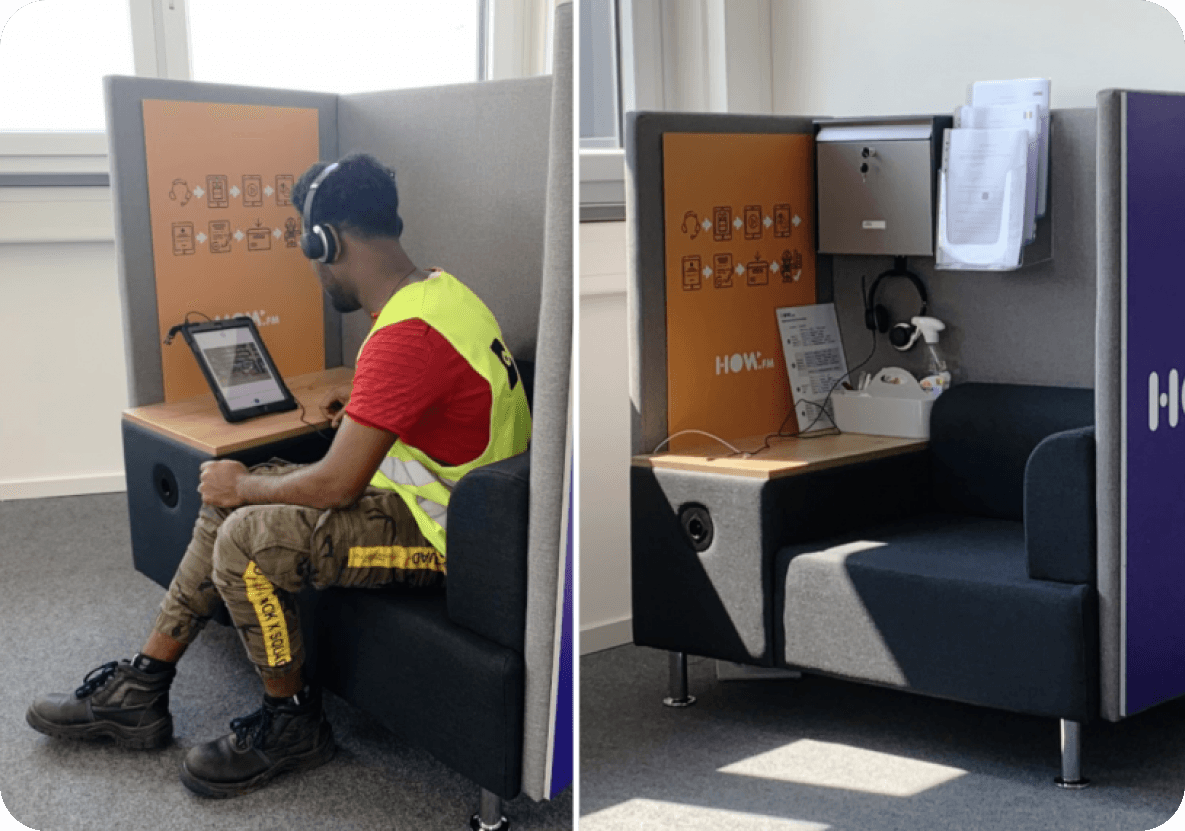 A warehouse employee at a Bohnen Logistik site training in how.fm’s training booth.
Training offered in over 30 languages means that workers can self-train regardless of what language they speak. A training program like this will allow you to hire temporary workers without experience and turn them into efficient picker packers quickly, without a lot of investment from your senior employees.
Is Previous Experience Necessary for Picker Packers?
While it may be convenient to have picker packers on the team who have done this kind of work in the past, it isn’t necessary. Limiting hires to workers who have previously done picking and packing will dramatically limit your options and increase the salary you’ll have to offer.
With how.fm, picker packers can self-train and be effective on the floor with little or no previous experience. Hiring picker packers without experience can help you find workers within your budget, attract applicants who see training as a valuable asset of the job, and make it more likely that you’ll attract longer-term employees.
Do Picker Packers Need To Use Forklifts or Other Machinery?
Depending on your warehouse, you may want picker packers who can also operate forklifts, pallet jacks, and other equipment. However, most larger warehouses separate the job of a picker packer from that of a forklift operator.
It isn’t usually necessary for a picker packer to operate a forklift in their typical work, so forklift skills can be seen as an extra benefit. Workers who can function as both picker packers and equipment operators are versatile employees, enabling you to cover gaps on the floor when employees are late or don’t show.
If you do encounter a picker packer who is also able to operate machinery, it may be worth offering a higher salary or other incentives to keep them with your company. You can also cross-train your best picker packers to be forklift operators.
What Should the Salary Be for Picker Packer Jobs?
The salary that you pay for picker packer jobs will vary depending on what prior experience the picker packer has and whether they can perform other tasks in your warehouse such as operating a forklift. It can be a challenge to decide whether or not to list the salary on your job listing.
If you don’t list the salary, you may be less likely to get as many qualified applicants. However, listing a salary means you’ll be locked into paying that salary even to someone with less experience.
A good option is to list a range, with the lower end for people with very little prior experience, particularly people who can only work on a temporary basis, and the higher end for people with equipment experience who will stay with your company for the long term. Here are some averages to help you pick an appropriate range:
Average Picker Packer Salary in Germany
- €17.12 / hour according to salaryexpert.com
- €12.00 / hour according to erieri.com
- €11.00 / hour according to glassdoor.com
- €10.60 / hour according to payscale.com
Average Picker Packer Salary in the US
- $16.29 / hour according to indeed.com
- $16.00 / hour according to salary.com
- $16.75 / hour according to talent.com
- $14.71 / hour according to zippia.com
What Actually Moves the Number
Averages only get you so far. In practice, a handful of factors decide where in the range a specific offer should land:
- Shift pattern. Nights, weekends, and rotating shifts justify premiums. If your ad is for a fixed early shift, say so; predictable hours are a genuine selling point that costs you nothing.
- Local labor market. A warehouse next to three competing fulfillment centers pays differently than one that is the largest employer in town. Check what nearby sites are advertising this month, not last year.
- Temp vs. permanent. Agency workers often cost more per hour than your own staff once fees are included. If you convert good temps to permanent contracts, factor that path into the range you publish.
- Certifications and cross-training. A picker with a valid forklift license or experience across multiple stations covers gaps in your roster. That versatility is worth paying for, and worth stating in the ad.
- Peak season. During peak, everyone in your region is hiring the same people. Temporary peak premiums or completion bonuses are a common tool; just be transparent about when they end.
One more honest note: pay gets candidates through the door, but it rarely keeps them. Poor training, chaotic first weeks, and unclear expectations drive far more resignations than a small wage gap. That side of retention is covered in our guide to onboarding warehouse workers.
Picker Packer Skills Matrix: What to Screen For and How
Use this matrix in interviews and during the first weeks on the floor. It keeps hiring decisions consistent across shifts and supervisors.
| Skill | What good looks like | How to assess it |
|---|---|---|
| Navigation | Learns zone layout within days; rarely asks for locations after week two | Ask candidates to describe how they learned a previous site; observe during a floor walk |
| Accuracy | Consistently low pick-error and mis-pack rates | Short practical exercise: match items against a sample pick list |
| Pace under pressure | Maintains rate during peak hours without cutting corners | Ask for a concrete example of a high-pressure day and what they changed |
| Reliability | Shows up on time, communicates absences early | Reference check with previous shift lead; probation attendance record |
| Safe handling | Lifts correctly, keeps aisles clear, reports damage | Observe during trial shift; ask what they would do with a damaged carton |
| Teamwork | Helps clear a colleague’s backlog without being asked | Behavioral question: “Tell me about covering for a no-show” |
You don’t need every candidate to score high on everything. Accuracy and reliability are the two you should never compromise on; pace and navigation improve quickly with good training.
Copy-Ready Picker Packer Job Description Template
Adapt the bracketed placeholders and this is ready to post. Keep the honest details in; they improve the quality of applications more than polished phrasing does.
Picker Packer (Warehouse) — [Location] — [Full-time / Part-time / Temporary]
The role. You pick customer orders with a handheld scanner, pack them securely, and get them to the right outbound lane on time. You are the last person to touch an order before the customer does, so accuracy matters as much as speed.
Your day.
- Pick items from assigned zones using [scanner / pick-by-voice / pick list]
- Check items for damage and match them against the order
- Pack orders in the correct carton with the correct label
- Keep your station stocked, clean, and safe
- Report inventory discrepancies and damaged goods immediately
What you bring.
- Comfortable standing and walking for a full shift and lifting up to [XX] kg / lbs
- Careful, accurate way of working, even when it gets busy
- Reliable attendance; you tell us early when something comes up
- No warehouse experience needed. We train you from day one, in your language.
Nice to have.
- Forklift or pallet-jack license
- Experience with scanners or warehouse management systems
What we offer.
- [€/$ XX–XX] per hour, [shift premiums if applicable]
- [Shift model: e.g., fixed early shift Mon–Fri, or 3-shift rotation]
- Paid, structured training in your first week; no experience required
- [Benefits: transport allowance, canteen, employee discount, conversion to permanent contract]
How to apply. [One sentence. Keep the application to a few minutes; hourly candidates abandon long forms.]
Two details in this template do a lot of work. Stating “we train you from day one, in your language” widens your applicant pool to motivated people other warehouses screen out. And naming the shift model up front saves both sides from interviews that end at “I can’t do nights.”
Common Mistakes in Picker Packer Job Ads
Before you post, check your draft against the failure modes we see most often:
- Requiring experience for a trainable job. If your training program is solid, experience requirements only shrink your pool and raise your wage bill.
- Hiding the shift pattern. Candidates who discover the real schedule at the interview drop out, and you have paid for the recruiting funnel twice.
- Vague physical requirements. “Physically fit” means nothing. State the walking, standing, and maximum lifting weight so people can self-select accurately.
- A laundry list of ten requirements. Every unnecessary requirement filters out good people. Pickers and packers need accuracy, reliability, and stamina; almost everything else is trainable.
- No mention of training. For candidates weighing two similar hourly offers, structured paid training is a differentiator. If you invest in it, advertise it. A job description for a related role, like a warehouse associate, should follow the same rules.
Picker and Packer Jobs for Your Warehouse Description Template With Salary Ranges in 2022
Now that you’ve informed yourself of the job skills necessary to hire pickers and packers for your warehouse, download the job description template to get started. Simply edit the template to fit your shop floor’s needs and post it on hiring platforms such as LinkedIn, Xing, and local job boards.
Writing the job ad is the easy half. The hard half is turning each new hire into a confident picker in days, not weeks, and doing it again every time someone leaves. That’s where how.fm helps: with self-paced training in 30+ languages, your new picker packers train themselves to standard while your team leads keep running the floor. Book a 15-minute product demo to see how it works.
Free download
Get your copy here
Share your details and we’ll send the editable picker packer job description template to your inbox.